LINES OF ZAHN - laminations layers of cells deposited over timer- Healing of Embol us involves adhesion to wall and re-canalization through clot. Both blood clot and embolus occur inside the circulatory system.

Deep Vein Thrombosis Dvt Ucla Pulmonary Vascular Disease Program Los Angeles Ca
An embolus is capable of traveling along the vessels.
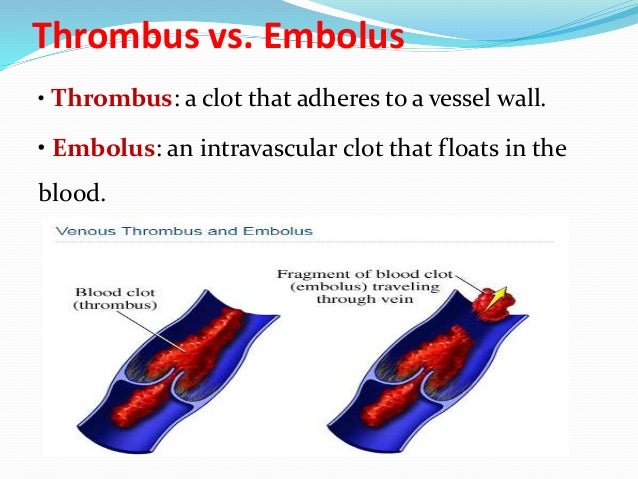
Thrombus vs embolus. What is Blood Clot Thrombosis and Embolism. A thrombus occurs in the legs pelvis arms or heart while an embolism occurs in the lungs. The pathogenesis of a thrombus formation can be explained by what is known as a Virchows triad which consists of a hypercoagulability state leukemia stasis of blood flow aneurysms or an injury to the blood vessel wall trauma atheroma.
Thrombus vs Embolus Thrombus is a blood clot that formed due to blood coagulation process. Both comprise of fat platelets a tumor amniotic fluid a tumor air or foreign substances. Summary - Thrombus vs Embolus.
An embolus stroke is caused by a piece of a blood. An embolus is a piece of a blood clot which is unattached and capable of travelling through the bloodstream. Thrombus is a blood clot that formed due to blood coagulation process.
Thrombosis occurs when a thrombus or blood clot develops in a blood vessel and reduces the flow of blood through the vessel. An embolus is a piece of a blood clot which is unattached and capable of travelling through the bloodstream. THROMBOSIS EMBOLISM AND INFARCTION 2.
The blood clot stops blood flow to the part of the brain causing the brain cells to die. However one thing common in. An embolus on the other hand is a floating clot that lodges somewhere.
Thrombus does not travel along the vessels. The main difference between thrombus and embolus is that thrombus refers to a firm mass of blood clot developed within the circulatory system whereas embolus refers to a piece of thrombus that travels through the blood vessels. In case the blood clot formed in the heart or the blood vessel is able to move to another part of the body it is known as embolus.
By contrast there are non-traveling blockages that develop locally from vascular trauma or epithelial pathology and vascular inflammation such as atheromata and thrombi. Disorders of blood cells for instance sickle cell disease or blood proteins can increase the chance of thrombus formation and therefore contribute to the risk of ischemic stroke. Published on March 26 2018 Thrombosis and embolisms are different conditions but theyre both characterized by a blood clot.
Both embolus and thrombus mean a blood clot. However if a thrombus breaks loose from its genesis site it becomes a thrombo-embolus and if not broken down during transit may cause embolism s. Thrombosis and embolisms are blockages in the blood vessels that require immediate medical treatment.
Thrombosis vs Embolism The difference between Thrombosis and Embolism is that Thrombosis is when the flow of blood is blocked because of the production of a blood clot within a blood vessel. An embolus is most often a piece of a thrombus that has broken free and is carried toward the brain by the bloodstream. The term thromboembolus is used a lot because it turns out that most emboli arise from thrombi.
On the other hand Embolism is when either the entire blood clot or a part of the blood clot is separated from its actual place causing an occlusion at another body part. Emboli usually break off from thrombi. Thrombus vs Embolus.
Thrombosis embolism and infarction 1. Embolism occurs when a piece of a. An embolus travels until it reaches the tiny blood vessels that are too small to pass through it.
CURRANT-JELLY CLOT - soft falls apartr- Pre-Mortem Thrombus Embolus. Movement Thrombus does not travel along the vessels. Normal Haemostasis Process of maintaining blood in a fluid clot free state in normal vasculature and rapidly forming a localized haemostatic plug at the site of vascular injury The pathologic opposite of haemostasis is thrombosis 3.
An embolus is capable of traveling along the vessels. Thrombus is a blood clot that is formed in the heart or the blood vessel and does not shift to another part of the body. Thrombosis can result in strokes heart attacks and pulmonary embolism.
Thrombosis blood clot formation and embolisms are different conditions. Thrombosis happens when a thrombus or blood clot forms in a. Thrombosis and embolism are obstructions that form in your vascular system and require immediate medical attention.
Differentiating clots Post-mortem Clot from Pre-Mortem Thrombus or Embolus r- Post-Mortem Clots. An embolus is a part of a thrombus that has broken off. For example part of a thrombus in a deep leg vein can break off and float upstream usually traveling nicely all the way up the inferior vena cava into the heart and out through the pulmonary arteries lodging in whatever vessel is too small to get through.